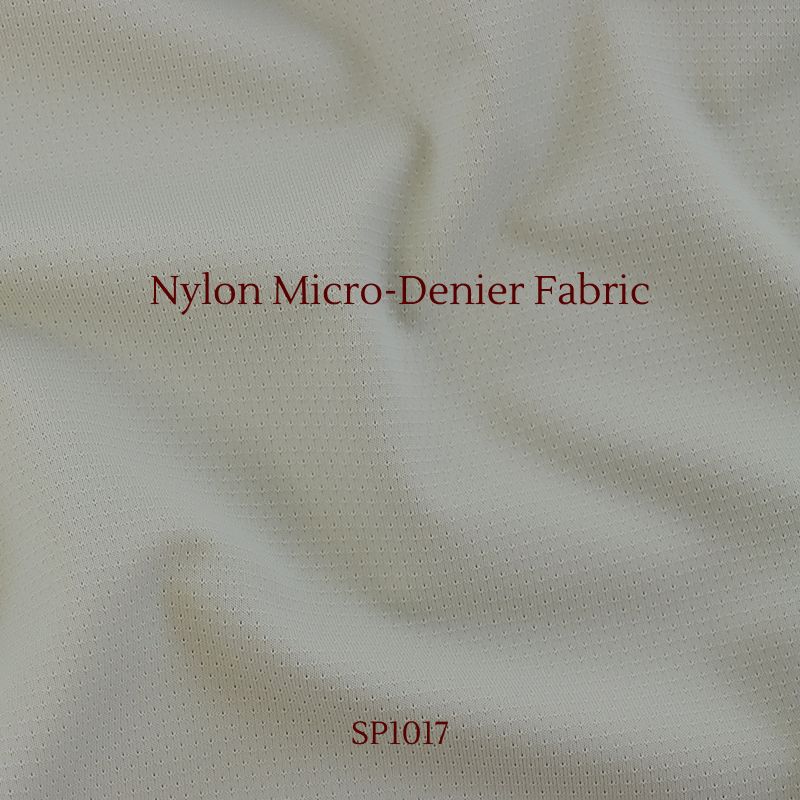
Micro-denier Nylon Breathable Fabric (SP1017)
Detailed introduction
The SP1017 micro-denier nylon breathable fabric has a smooth, lightweight hand and good resilience, making it ideal for sportswear, underwear, functional garments, and close-fitting pieces. The surface features a regular microporous structure for excellent breathability, allowing sweat to dissipate quickly for a dry, comfortable feel. It also offers good abrasion resistance and strength, resists deformation and pilling, and is easy to care for. Colors are pure and the surface is even, suitable for moisture-wicking jerseys, running shorts, yoga wear, and breathable linings. Cut pieces have a natural drape that fits close to the body without restricting movement, balancing practicality and aesthetics. Whether for everyday exercise or high-intensity training, it provides long-lasting comfort. Custom printing and dyeing services are available to support small-batch branded production. Want details on GSM, composition ratios, or to request samples? Message me to receive detailed specifications, fabric hand-feel videos, and sample shipping options for quick production and OEM coordination to make your design process easier and more efficient.
Ordering Instructions
Minimum order quantity:5000 Usd
Delivery lead time:Delivery Time To Be Negotiated Based On Order Quantity
Customization services MOQ:All Fabrics Can Be Customized According To Samples
Customization options:Material customization, Custom specifications, Color customization, Pattern customization, Feature customization, Custom packaging
Qualifications and Certifications and Honors
Multiple international certifications, strict quality control, safeguarding your procurement.

Oeko-tex Standard 100 Certification Certificate
Prove that textiles comply with ecological safety standards

Oeko-tex Standard 100 Certificate
Prove that textiles comply with ecological safety standards
.jpg?v=rOLP8V)
Grs Global Recycled Standard Certification Certificate
Prove that textiles meet recycling standard requirements

Grs Global Recycled Standard Certification Certificate
Prove that the enterprise complies with the relevant requirements of the recycling standards
Factory real-world display
Modernized production line, strict quality inspection process, ensuring the quality of every product is outstanding
📹 Watch the full process of our production line, from raw materials intake to finished goods outbound, every step is strictly controlled。 Advanced automated equipment, paired with an experienced technical team, ensures product quality is stable and reliable。
Product Information Center
Get detailed product information, to help you quickly make purchasing decisions.
Zhejiang Pu'an Textile Technology Fabric Price List
Summarize parameters of various textile fabrics and corresponding minimum order quantity rules
Puan Textile Fabric Product Catalog
Summarize parameters, specifications, and pricing methods for various types of textile fabrics.
OEM/ODM Customization Services
Professional customized services,to build your own brand products
Flexible minimum order quantity, to meet the customization needs of different scales.
Material customization
Choose specific materials and formulations, to optimize product performance
Custom specifications
Customizable product specifications such as width, length, and thickness to meet special requirements.
Color customization
Custom colors,create unique products
Pattern customization
Custom printed patterns and designs, to meet brand promotional needs
Feature customization
Customize special features according to application scenarios,improve product performance
Custom packaging
Packaging solutions tailored to brand requirements
Ready to start your customized project?
Our professional team will provide you with one-on-one consulting service.
From design to production, we provide end-to-end support for your customization needs.
After-sales service process and cases
A comprehensive after-sales system that makes your purchasing worry-free
After-sales service process
4 steps to efficiently resolve your after-sales issues, the professional team will follow up throughout the entire process
Submit after-sales application
Submit your application via WhatsApp, email, or online customer service.
Rapid response
Respond on the same business day,confirm the issue and provide a solution.
Problem handling
Technical support arranged within 48 hours
Follow-up feedback
Full follow-up throughout the process until the issue is fully resolved.
After-sales service case
Real customer cases, witness our professional service and commitment
Case Of Batch Returns And Exchanges For All-polyester Fabric Due To Weight Deviation And Color Difference
An overseas customer (*** company) ordered 120,000 meters of all-polyester fabric, to be shipped in 3 batches. After the first batch of 40,000 meters arrived at port, the customer's quality inspection found that the actual gram weight was 118g/m², a deviation of 5.6% from the contracted 125g/m², exceeding the 3% tolerance range. Additionally, the dark blue batch (20,000 meters) showed obvious batch-to-batch color difference, with left-right color difference ΔE values within the same roll reaching 1.8-2.3, far exceeding the acceptable ΔE≤1.0 standard for foreign trade bulk goods. The customer requires a full return and replacement of the entire batch, and claims compensation for the port demurrage charges and inspection fees already incurred.
1. Urgently retrieve factory production records and retained samples to confirm that the weight deviation was caused by improper adjustment of weaving process parameters, and the color difference issue originated from a malfunction in the dyeing vat temperature control system. 2. After negotiation with the customer, an agreement was reached: the first 20,000 meters of dark blue fabric out of the initial 40,000 meters are to be fully returned, while the remaining 20,000 meters (non-dark blue) will be accepted at 85% of the contract price; simultaneously, the factory will arrange to re-produce 40,000 meters, of which 20,000 meters are a re-order of dark blue and 20,000 meters are an equal-quantity replenishment. 3. All reworked fabrics must be issued with weight and color fastness reports by a third-party inspection agency (SGS) before leaving the factory, and each roll must be labeled with the dye lot number and weight data. 4. Our side will bear the return freight, customer port charges, and inspection fees totaling USD 6,800, and commit to shortening the delivery time by 7 days, with 2,000 meters of emergency fabric sent by air freight for the customer's initial production.
The returned fabric was re-inspected by the factory and downgraded for domestic sale; the replenished fabric was produced within the agreed delivery period, passed all SGS tests, and upon arrival at the port, the customer randomly inspected 20 rolls, with an average gram weight of 124.3 g/m² and color difference ΔE all ≤ 0.8. The customer acknowledged the handling plan and agreed to continue executing the remaining 80,000 meters of the original order. The cooperative relationship between both parties remained unaffected.
Remote Technical Support Case For Color Difference Complaint From Overseas Key Account On 100% Polyester Fabric
A European clothing brand buyer ordered a total of 120,000 meters of polyester fabric from our company through a B2B platform, to be delivered in 3 batches by sea. After receiving the first batch, the customer reported during spot inspection that some batches of fabric had color differences, especially dark-colored fabrics, which showed obvious visual differences under natural light. The customer requested a full return and compensation claim. Due to a 7-hour time difference between the customer's location and our company, we could not handle the issue on-site immediately, and the customer urgently needed production scheduling. Phone communication could not confirm the actual situation.
Our company has initiated the remote technical support service process: First, we arrange for a technical service engineer to connect via video conference with the customer's warehouse quality inspection personnel, guiding them to conduct gray scale rating in accordance with the international standard (ISO 105-A02), and remotely compare and confirm whether the color difference level exceeds grade 4. At the same time, we retrieve the production records and factory inspection reports for this batch, and discover that a change in the raw material batch number led to a slight adjustment in the dyeing machine formula. The engineer then remotely guides the customer to adjust the cutting batch allocation plan, grouping rolls with similar color differences for use together, and records a detailed color difference classification instructional video to send to the customer, assisting the customer's quality inspection team in establishing a new incoming inspection standard.
Through remote technical guidance, the customer completed the graded re-inspection of all 78 rolls of fabric within 48 hours, confirming that the actual color difference did not affect the appearance of the finished product, and only needed to use rolls with similar color differences together. The customer accepted this solution and did not return the goods. The subsequent 2 batches of goods passed acceptance smoothly according to the new inspection standards. Our company also adjusted the raw material batch control process at the production end to avoid similar problems from recurring. The customer subsequently placed an additional order of 180,000 meters and proactively paid the technical service fee, expressing high recognition of our remote response speed.
Training Service Case For Bulk Pure Polyester Fabric Finishing Process
The customer purchased 500,000 meters of 100% polyester fabric (Order No.: ***). During garment processing, they reported severe shrinkage exceeding standards and insufficient color fastness, with a claim amount as high as USD 300,000. After remote troubleshooting by our technical team and testing of returned samples, it was confirmed that the fabric's physical and chemical indicators were qualified. The root cause was the customer's factory using non-standard high-temperature setting processes and alkaline dyeing post-treatment procedures, leading to fabric shrinkage and fading.
We have immediately initiated our after-sales service process, dispatching 2 senior technical engineers to fly to the customer's factory (location: ***) to conduct a 3-day on-site special training service: 1) Explain the correct high-temperature heat-setting temperature, time, and tension control parameters based on the fiber characteristics of polyester fabrics; 2) Demonstrate standard post-dyeing neutralization, washing, and color fixation operations to correct their alkaline residue problem; 3) Provide bilingual (Chinese-English) "Polyester Fabric Processing Operation Manual" and video tutorials, and guide the customer on-site in adjusting production line process parameters; 4) Train the customer's factory quality control personnel on rapid testing methods for fabric shrinkage rate and color fastness.
The customer re-produced according to the process after training. The fabric shrinkage rate dropped from the original 5.2% to within 1.8%, and the color fastness reached grade 4 or above. All subsequent 200,000 meters of fabric passed acceptance. The customer withdrew the claim application and placed an additional repeat order of 300,000 meters, while also listing our company as an annual strategic supplier. This training service not only resolved the quality dispute but also significantly improved the customer's processing technology level and enhanced customer loyalty.
Any after-sales issues?Our professional team is at your service at all times.
About Us
Zhejiang Puan Textile Technology Co., Ltd.
Address
Zhejiang, China
Prioritize Responding To New Customer Inquiries